Hard Water Stains: What Actually Removes Them, and What Stops Them Coming Back
Mesa water leaves scale on everything. What removes existing hard water stains from glass, chrome and tile, and the one change that stops them returning.
By JB Water & Air · August 31, 2026 · 4 min read
The short version: Hard water stains are mineral deposits, so an acid removes them and scrubbing does not. Vinegar handles light deposits; a descaler handles heavy ones. But cleaning only ever addresses what has already formed — the deposits return because the minerals are dissolved in the water itself.
What you are actually looking at
The white film on the shower door, the crust around the faucet aerator, the spots on glassware that survive the dishwasher — none of that is dirt.
Arizona water carries a lot of dissolved calcium and magnesium. When a drop evaporates, the water leaves and the minerals stay. Do that a few thousand times on the same square inch of glass and you get a bonded deposit that a sponge will not shift, because there is nothing to wipe away. It has to be dissolved.
That is the whole reason the usual approach fails. People scrub harder, buy a stronger cleaner, and scratch the glass without touching the deposit.
What removes it
Light deposits — white vinegar. Warm it slightly, apply it, give it ten to fifteen minutes to work, then wipe and rinse. On shower glass, a cloth soaked in vinegar and held against the glass beats spraying, which just runs off.
Heavier deposits — a dedicated descaler. Products built for limescale use stronger acids and are worth it once a deposit has years behind it. Follow the label, ventilate, and rinse thoroughly.
Faucet aerators and shower heads — soak them. Unscrew the aerator, drop it in a cup of vinegar overnight, and rinse. For a shower head that will not come off, a bag of vinegar rubber-banded over it does the same job. A restored aerator often fixes "low pressure" that was never a pressure problem at all.
Do not use acid on natural stone. Marble, travertine and granite etch permanently. Use a cleaner made for stone.
Do not use a blade or an abrasive pad on glass. You will remove the deposit and the surface with it, and etched glass cannot be undone.
Why it keeps coming back
Because none of the above changes the water.
Cleaning removes the deposits that have already formed. The next shower puts more minerals on the same glass. This is the loop most Valley households are stuck in — clean, watch it return, clean again, eventually stop bothering.
The part that costs real money
The visible stains are the annoying part. They are not the expensive part.
The same minerals are collecting inside the plumbing and inside every appliance the water touches:
- Water heaters. Sediment settles on the bottom of the tank, insulating the burner from the water. The tank works harder, the bottom runs hotter, and it fails earlier than the label promised. (There is a whole guide to flushing one if that is where you are.)
- Dishwashers and washing machines. Scale on heating elements and valves shortens their life the same way.
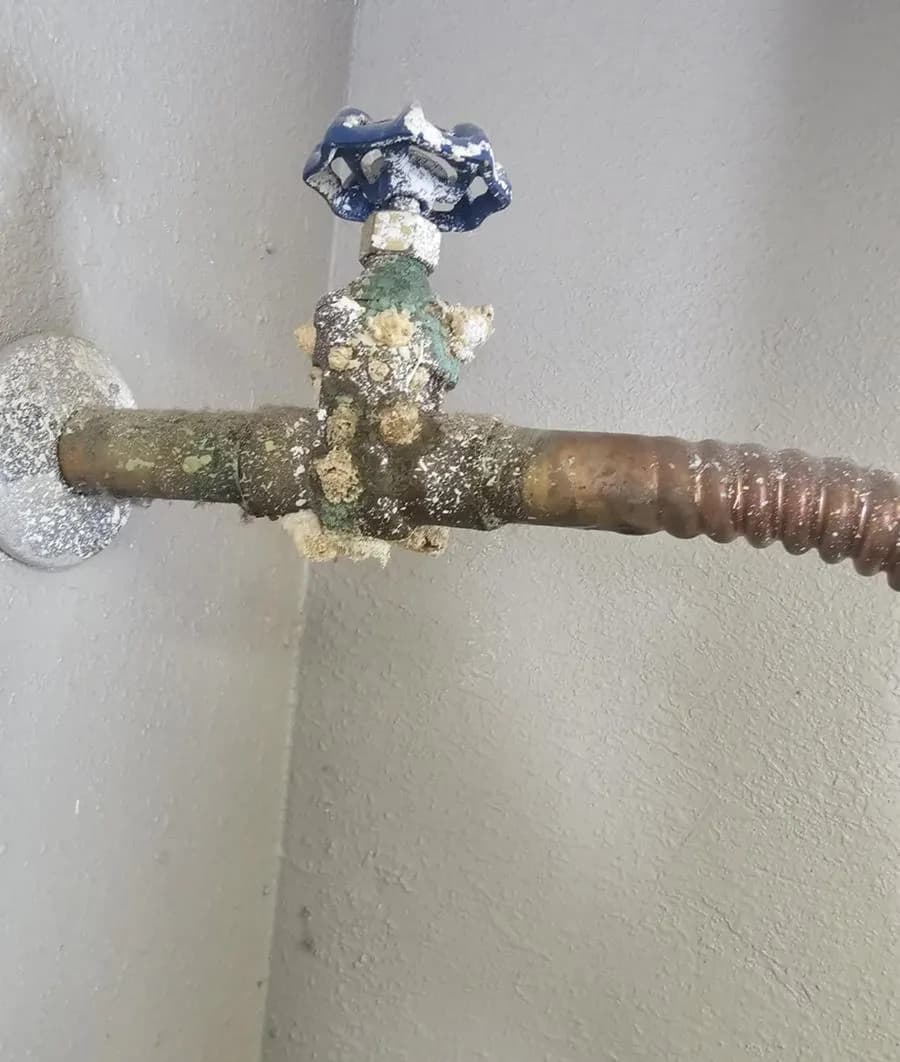
- Fixtures and valves. The photo at the top of this article is a real shut-off valve from a Mesa service call. That much build-up means the valve will not close when you actually need it to — which is generally the moment you discover it.
None of that is visible until something stops working.
What actually breaks the loop
A water softener removes the calcium and magnesium before the water reaches anything. New deposits stop forming. Existing scale still has to be cleaned off once, but it does not come back in the same way.
A whole-home filtration system handles a broader range of what is in the supply, and is often paired with softening rather than chosen instead of it.
Reverse osmosis at the kitchen tap deals with drinking and cooking water specifically, which is where taste matters most.
Which of those makes sense depends on your water and your house, and anyone who quotes you a system without asking what is actually in your supply is guessing. That is what a water test is for.
Why we care about this more than most plumbers
This company started with water, not with pipes.
In 1981 John Bevell bought a water distiller for his wife's health. He thought it was worth telling people about, started promoting it to friends and neighbours, and over the next two decades built that into a business serving more than 800 customers. He served on the board of the Arizona Water Quality Association and spent a good deal of time explaining steam distillation to other people in the trade.
The plumbing and HVAC came later. Water treatment is where JB Water & Air actually began, and it is still the part of the job we are most opinionated about.
Where to start
Clean what is there — vinegar for light, a descaler for heavy, soak the aerators. You will get the shine back.
Then decide whether you want to keep doing that indefinitely, or change the water. If it is the second, get a quote or call and we will start by finding out what is actually in your supply rather than selling you a system off a shelf.
Frequently asked questions
- What removes hard water stains?
- An acid dissolves the mineral. White vinegar works on light deposits, and a dedicated descaler works on heavier ones. Scrubbing alone does not, because the deposit is bonded mineral rather than dirt sitting on the surface.
- Why do hard water stains keep coming back?
- Because the minerals are dissolved in the water itself. Cleaning removes what has already been deposited; every subsequent drop that evaporates leaves more behind. Only changing the water changes the outcome.
- Does vinegar damage fixtures?
- On chrome, glass and ceramic it is generally fine if it is rinsed off rather than left to sit for hours. Keep it away from natural stone such as marble, travertine and granite, where acid etches the surface permanently.
- Will a water softener remove existing stains?
- No. A softener changes the water going forward, so new deposits stop forming. Existing scale still has to be cleaned off once, after which it should not return in the same way.
- Is hard water bad for you?
- Hard water is a nuisance issue rather than a health one — the minerals involved are calcium and magnesium. The damage it does is to fixtures, appliances and water heaters, which is where the cost shows up.