Water Heater Installation Cost Mesa 2026: Tank vs Tankless
Tank water heaters run $882-$2,300 installed and last 8-12 years, while tankless systems cost $1,400-$4,000 but deliver 15-20 years of service and 24-34% bet
By JB Water & Air · July 1, 2026 · 31 min read
Summary Tank water heaters run $882-$2,300 installed and last 8-12 years, while tankless systems cost $1,400-$4,000 but deliver 15-20 years of service and 24-34% better energy efficiency. Mesa’s hard water and desert heat make sizing and maintenence critical to avoiding premature replacement and surprise costs.
Understanding Water Heater Installation Costs in Mesa
Tank units typically cost $882-$2,300 installed, while tankless systems run $1,400-$4,000 depending on your home’s size and fuel type.
JB Water believes in — for our team and for the Arizona families we serve. Every service call is a chance to leave a home better than we found it.
Average Pricing Overview
Water heater installation costs split into two clear tiers based on system type. A standard tank unit runs $882-$2,300 installed, while tankless systems range from $1,400 to $4,000.[1] The national average across both types sits around $1,400, though many homeowners land closer to $1,950 once permits, venting, and old-unit removal are included.[2][3] For a closer look at what shapes those numbers in the Valley, what is the typical cost to install a hot water heater breaks down the local variables worth knowing before you call a plumber.
| System type | Installed cost range | Approximate average | Typical labor time |
|---|---|---|---|
| Tank (gas or electric) | $882-$2,300 | ~$1,339 | 1-3 hours |
| Tankless | $1,400-$4,000 | ~$2,800 | 4-6 hours |
Labor accounts for 18%-50% of your total bill, with plumbers charging $45-$200 per hour depending on job complexity.[2][3] Tank-to-tankless conversions push toward the high end because they often require gas line work, electrical panel upgrades, and new venting — each billed on top of the unit price itself.[1]
Factors Influencing Installation Costs
Several variables push your final bill well beyond the unit price alone. Tank capacity is one lever: a 50-gallon tank suits most Mesa households, but sizing up to 80 gallons for a larger family adds unit cost without significantly changing labor time.[4] Tankless systems introduce a different sizing metric — gallons per minute (GPM) — where a higher-flow unit for a home with 4+ bathrooms often requires upgraded gas lines or electrical connections, each billed as a seperate line item on top of the unit price.[4] Energy efficiency rating, measured as Uniform Energy Factor (UEF), moves the purchase price too: a gas tank unit with a 0.60 UEF costs roughly $600, while a comparable 0.90 UEF model runs about $720 — a $120 gap that pays back in approximately 14 months through energy savings.[4]
Fuel type and existing infrastructure shape costs more than almost any other single factor. Gas models run 10-20% more than electric equivalents at purchase, but the bigger swing comes from what’s already in your walls.[4] Homes with galvanized supply lines require replacement with copper before a new unit can connect — an upgrade adding $500-$2,500 depending on scope — while a new electric circuit for an electric unit brings an electrician’s hourly rate into the equation on top of your plumber’s.[4] Mesa’s hard water complicates matters further: at 17 grains per gallon, local mineral content sits among the highest in the Phoenix metro, accelerating sediment buildup and component wear that shortens equipment life well below national averages.[6] Understanding why water heaters are so expensive to install in this context helps Mesa homeowners budget accurately before scheduling a job.
Permits and disposal round out the cost picture. Most Mesa-area municipalities require a permit for water heater installation, and your plumber will either quote it separately or fold it into their total — confirm which before signing anything.[4] Removal and disposal of the old unit typically runs $100-$500, and skipping that question upfront is one of the most common sources of invoice surprises.[5]
| Cost factor | What drives it higher | Typical added cost |
|---|---|---|
| Tank capacity | Larger tank (80 gal vs. 50 gal) | Unit price only; minimal extra labor |
| Tankless GPM rating | Higher flow rate (9 GPM vs. 5 GPM) | Gas/electrical upgrade: $500-$2,500 |
| UEF efficiency rating | Higher-efficiency model (0.90 vs. 0.60 UEF) | ~$120 more upfront per unit |
| Existing pipe material | Galvanized lines needing copper replacement | $500-$2,500 |
| New electrical circuit | Added circuit breaker for electric unit | Electrician hours on top of plumber |
| Permits and disposal | Required by local code; old-unit removal | $100-$500 combined |
Seasonal Pricing Trends 2026
Mesa’s desert climate creates predictable windows where water heater installation costs shift noticeably. Plumbing companies typically offer lower rates during off-peak months when service demand drops — in the Phoenix metro, that’s generally late fall and early spring, before summer heat waves and winter cold snaps push emergency call volumes up.[8] Timing a planned replacement into those quieter windows can mean the difference between standard scheduling and a premium rush fee. Emergency installations, which spike when aging tank units fail under July’s sustained heat stress, routinely add 20% or more to the total bill.[8] The practical takeaway: replacing a water heater before it fails — rather than after — is the most reliable way to avoid peak-season pricing in Mesa.
2026 also resets the incentive landscape in a meaningful way. The federal 25C tax credit, which covered up to $2,000 on ENERGY STAR-certified heat pump water heaters, expired at the end of 2025.[7] Homeowners who were factoring that offset into their budget for a tank-to-heat-pump upgrade need to recalculate. That said, heat pump water heaters operate most efficiently in warm climates, and Mesa’s year-round heat keeps these units closer to peak efficiency than they’d reach in colder regions.[9] State and utility rebates may still partially close the cost gap, so confirm what’s available with your utility provider before scheduling. For active seasonal promotions locally, JB Water & Air’s hot offers page lists current deals worth checking before you book.
Local JB Water & Air Service Benefits
What separates a local contractor from a national chain is accountability after the job is done — not just during it.
JB Water & Air is a family-owned Mesa operation with 27 years of experience covering water heater installation, gas lines, water treatment, and drain work, so one call typically handles most of what can go wrong in a Valley home.[10] Emergency services are available around the clock, which matters directly when a tank fails mid-July at 115 degreesF and a multi-day wait for a scheduling window isn’t realistic.[10] Financing is available for larger projects, including the kind of tank-to-tankless conversions that require gas line upgrades or panel work on top of the unit price itself.[11] Verified Angi reviews show a 5.0 rating across completed jobs, with customers specifically noting prompt arrival, professional crews, and clean worksites after completion — one reviewer flagged that crews even dispatched additional teams mid-job to keep a complex slab-leak reroute on schedule.[10] For Mesa homeowners who want a single local company handling plumbing, HVAC, and water treatment under one roof, that breadth of service is worth factoring into the hiring decision before the first cold shower.
Tank Water Heaters: Value and Installation Details
Tank water heaters use a simple design with a heating element and thermostat, but sediment buildup in Mesa’s mineral-heavy water requires annual maintenence to prevent failure.
JB Water believes in : we treat your home, your time, and your budget the way we would want our own treated.
How Tank Heaters Work
A tank water heater is simpler than most homeowners expect: a metal cylinder filled with water, a heating mechanism at the bottom or inside, and a thermostat to hold temperature.[12] Cold water enters at the bottom through a dip tube, gets heated by either a gas burner or an electric element, and rises naturally to the top of the tank — where the heat-out pipe sits — ready to deliver hot water the moment you open a faucet.[12][14] Most manufacturers recommend setting the thermostat between 120-140 degreesF, which covers household demand without creating a scalding risk.[12]
Electric models run two heating elements — one near the top of the tank, one near the bottom — each paired with its own thermostat.[13] The upper thermostat is the primary controller: it decides which element energizes depending on where in the tank the temperature drops first.[13] Elements only run one at a time, but because heating starts as soon as a temperature drop is detected, a 40-gallon tank can deliver more than 50 gallons of hot water within an hour — a spec called the first-hour rating that matters when you’re sizing a replacement.[13]
Sediment is the main threat to long-term tank performance, and Mesa’s mineral-heavy water makes it a more pressing concern than in most cities. Calcium and magnesium settle to the tank floor over time, shrinking usable storage capacity and, in electric units, eventually burying the lower element until it overheats and fails.[13] A plumber can flush most of that buildup during annual maintenance before it becomes a repair call. If you’re already noticing inconsistent temperatures or longer recovery times between showers, signs your hot water heater is going out covers what to check before scheduling a service visit.
Typical Installation Process
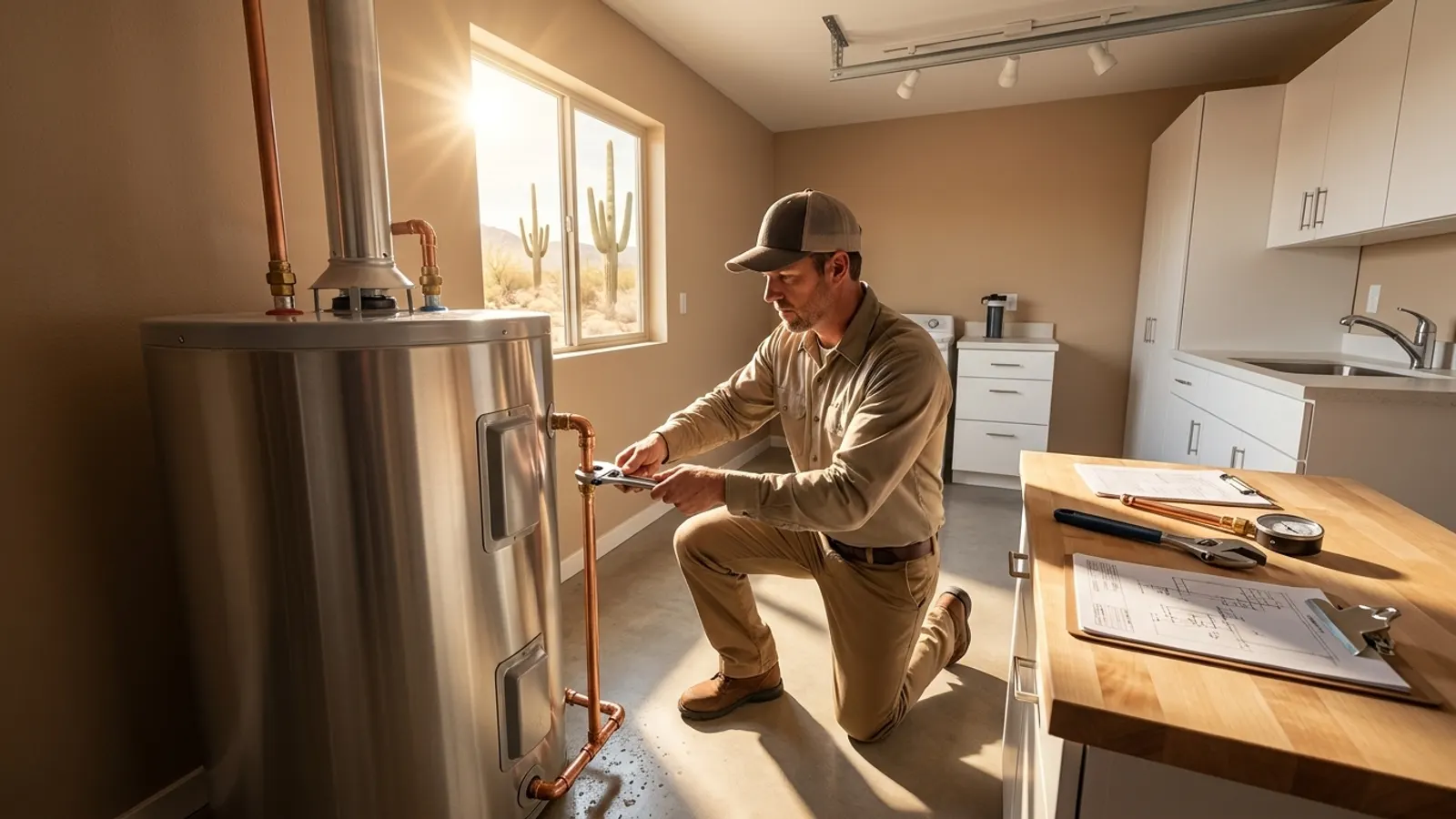
A standard tank water heater installation follows a predictable sequence that most plumbers complete within one to three hours, assuming no surprises behind the walls.
The job begins with shutting off the cold water supply and gas or electrical feed to the existing unit, then draining the tank before disconnecting supply and discharge lines.[15] Old-unit removal and proper disposal comes next — skipping this conversation before the plumber arrives is a common source of invoice surprises, so confirm it’s included upfront.[16] Once the space is clear, the plumber prepares the mounting area, checks that existing gas or electrical connections meet the new unit’s specifications, and verifies that venting is properly routed and up to local code.[15] In Mesa homes with older galvanized supply lines, a plumber may pause here to assess whether those lines need replacing before the new tank can connect safely — a step that adds time and cost but prevents premature corrosion on new equipment.[17] After the unit is set and connected, the plumber pressurizes the system, checks every connection for leaks, and confirms the thermostat and safety relief valve are operating correctly before restoring the water supply.[15] The job finishes with a full system test and a brief walkthrough — what temperature the thermostat is set to, how to read the pressure relief valve, and what annual maintenance looks like given Mesa’s hard water.[17] If you want a clearer picture of how long each phase actually takes, how long it takes a plumber to replace a hot water heater breaks it down by job type and complication level.
Cost Breakdown for Tank Units
Understanding where the money actually goes makes it easier to evaluate quotes and spot line items that don’t belong. A standard tank unit itself costs $600-$1,000 for the equipment, with 40-gallon models landing near the lower end and 80-gallon units pushing toward the top.[1] Labor adds $300-$800 on top of the unit price — lower when the space is open and accessible, higher when the plumber has to maneuver the unit down narrow stairs or into a cramped utility closet.[3] Gas models bring an additional $300-$500 for venting and $100-$200 for water line connections, which is why a fully installed gas tank heater lands between $1,200 and $2,300 in most Mesa homes.[1][3] National cost data from May 2026 puts the average replacement closer to $1,586-$1,843 once all components are included, which aligns with what Valley plumbers typically quote for a like-for-like tank swap.[18]
Tank size has the most direct impact on total cost, and getting the sizing right matters both for upfront budget and daily performance. A 40-gallon tank suits a household of two to three people and installs for $600-$1,200 all-in; bracing for the added floor weight adds $100-$200 where needed.[3] An 80-gallon unit for a family of five or more pushes the installed range to $1,000-$3,000, with some older floor structures requiring $300-$800 in reinforcement before the heater can safely sit on them.[3] Electric models average around $850 for the unit; gas models run close to $800 before venting costs — a slim difference at purchase that compounds once the 58%-60% efficiency rating on tank units is weighed against a lifespan of 8-12 years.[3] If your existing tank is already approaching that window and repair quotes are climbing, understanding whether repair still makes financial sense can save you from paying twice within a few years.
The table below shows how each cost component stacks up for a standard 40-gallon replacement in Mesa:
| Cost component | Electric tank | Gas tank |
|---|---|---|
| Unit (40 gal) | ~$850 | ~$800 |
| Labor | $300-$800 | $300-$800 |
| Venting | Not required | $300-$500 |
| Water line connections | $100-$200 | $100-$200 |
| Permits | $25-$300 | $25-$300 |
| Old unit removal | $100-$500 | $100-$500 |
| Typical installed total | $1,200-$2,300 | $1,300-$2,300 |
One line item worth confirming upfront: old-unit removal. It costs $100-$500 depending on access difficulty and your plumber’s hourly rate, and it’s one of the most common sources of invoice surprises when it isn’t discussed before the job starts.[1]
Why Mesa Homeowners Trust JB Water & Air
What often sets one plumber apart from another isn’t the install itself — it’s what happens before and after.
The pricing model here is straightforward: a $65 diagnostic visit to assess your situation and walk through every option, followed by a to-the-penny quote before any work begins.[19] No obligation to proceed, no fuzzy estimates that balloon once the crew shows up.
For a tank water heater installation where labor variables like pipe condition or cramped access can shift costs quickly, knowing the exact number upfront removes the most common source of post-job frustration.[19] Beyond the quote, every labor job is backed by a 2-year guarantee — meaning if something isn’t right after installation, the fix doesn’t cost you extra.[20] First-time customers also get their plumbing, water treatment, and HVAC systems documented during the visit, which turns a single water heater call into a forward-looking plan for the whole house rather than a one-and-done transaction.[19] For Mesa homeowners who want transparent pricing tied to a guarantee they can actually hold someone accountable to, the 2026 pricing and service details outline exactly what that commitment looks like in writing.[20]
Tankless Water Heaters: Modern Choice and Installation
Tankless water heaters activate only when you open a faucet, eliminating the standby energy loss that tank units consume around the clock.
JB Water believes in . That is why our workmanship is backed by a 2-year guarantee — if something is not right, we make it right.
How Tankless Systems Operate
Unlike a tank unit that keeps water hot around the clock, a tankless heater activates only when a faucet opens.[21] Cold water entering the unit passes over a flow sensor — with activation thresholds as low as 0.4 gallons per minute — which signals the control board to ignite the gas burner or energize the electric heating elements.[22][23] Water moves through a heat exchanger, absorbs heat, and exits at your set temperature within seconds.[23] Close the faucet and the flow sensor detects zero movement, shutting the unit off completely — no fuel or electricity consumed until the next demand.[21] That on/off cycle is what eliminates the standby energy loss that accounts for a measurable share of a tank heater’s operating cost.
Gas and electric models reach the same result through different internal paths. Electric units use copper or stainless-steel heating coils — the control board modulates their power output to match the incoming flow rate, so a quick hand rinse draws less energy than a full shower.[23] Gas models push water over a heat exchanger warmed by a burner and deliver higher flow rates, typically 2-5 gallons per minute for most residential units, making them better suited to larger households.[21] For Mesa homes already on natural gas, the infrastructure question mainly comes down to whether the existing supply line is sized for the additional BTU load; if it isn’t, gas line work becomes a required part of the water heater installation before the unit can be commissioned safely.[23]
Condensing versus non-condensing is a distinction worth understanding because it directly shapes venting costs. A condensing unit uses two heat exchangers: incoming water passes through a secondary exchanger first, capturing heat from exhaust gases before they leave the unit.[22] Because the process cools exhaust significantly, condensing models can vent through lower-cost PVC pipe rather than stainless steel.[22] Non-condensing units have a single heat exchanger, discharge exhaust at a much higher temperature, and require metal venting with a dedicated exterior termination point.[22] Condensing units cost more upfront but frequently recoup part of that gap through reduced venting material costs and slightly better heat recovery over time.
One physical constraint shapes every tankless purchase decision: flow rate is fixed, not expandable mid-use.[21] Running a shower and the dishwasher simultaneously can push a single unit past its heating capacity, delivering lukewarm water to one fixture.[23] The workable solution is correct sizing from the start — calculating the combined GPM of every fixture likely to run at the same time, then matching that number to a unit’s rated output rather than its maximum ceiling.[23] In a Mesa home where summer heat means post-yard-work showers regularly overlap with evening dishes, that simultaneous-use math is worth doing before the purchase, not after the first cold-water complaint.
Installation Steps for Tankless Units
A tankless water heater installation runs 4-8 hours — roughly double the time of a like-for-like tank swap — because the process touches gas lines, electrical panels, and venting in ways a standard tank replacement rarely does.[24] Fuel type, local building codes, and the condition of existing infrastructure all determine how smoothly each phase goes, which is why Mesa code generally requires a licensed contractor rather than a handyman for this work.[21] Permits are mandatory in most Valley municipalities, and scheduling the required inspection can push the total project window out by a day or two beyond the installation itself — confirm whether your contractor pulls the permit or whether you’re expected to arrange it separately.[21]
The installation follows a fixed sequence:
- Shut off utilities and drain the old unit. Cut the cold water supply, then shut off gas or electrical power to the existing heater. Drain the tank fully before disconnecting supply and discharge lines to prevent spills during removal.[24]
- Remove the old unit and inspect the area. Once the old heater is out, the plumber checks for corrosion, pipe damage, or infrastructure that won’t meet the new unit’s specifications — including whether the gas supply line is sized for the tankless unit’s higher BTU demand or whether the electrical panel has capacity for a dedicated circuit.[24]
- Position and secure the new unit. Unlike a floor-standing tank, most tankless units mount to the wall. The plumber confirms the surface can bear the load and that the unit is level before any connections are made.[24]
- Make gas or electrical connections. Gas models connect to the supply line, with the plumber verifying adequate BTU capacity at that point in the system. Electric models require a dedicated circuit; if one doesn’t exist, an electrician installs it at this stage — a separate line item on your invoice.[21]
- Connect water lines. Cold-in and hot-out lines attach to the unit, with the plumber confirming correct flow direction and proper placement of isolation valves for future service access.[24]
- Install venting. Gas tankless units require an exhaust path to an exterior termination point. Condensing models can use PVC pipe; non-condensing units need metal duct rated for higher exhaust temperatures — a distinction that directly affects venting material costs.[24]
- Test and commission. With utilities restored, the plumber pressurizes the system, checks every connection for leaks, and runs a flow test to confirm the unit activates at the correct threshold and delivers water at the set temperature before signing off.[24]
One step that catches homeowners off guard: if your existing gas line isn’t sized for the new unit’s BTU load, the plumber stops and sizes up the line before proceeding — an upgrade that adds both time and cost but is required for the unit to operate safely.[21] Getting that assessment done during the initial quote visit rather than mid-installation prevents the kind of same-day cost surprises that make a planned upgrade feel like an emergency.
2026 Pricing and Savings
Tankless water heater installation in 2026 runs $1,400-$3,900 fully installed — a wider range than tank units because conversion projects often layer gas line work, electrical upgrades, and specialized venting on top of the unit price.[1] That upfront premium comes with a meaningful trade-off: tankless units reduce energy bills by 24%-34% compared to conventional tank heaters, and the Department of Energy puts their lifespan at up to 20 years — nearly double the 8-12 years most Mesa tank heaters achieve before hard water and summer heat force a replacement.[25] Running those two figures together, a tankless unit frequently costs less per year of service than a tank heater replaced twice in the same ownership window.
Material costs have shifted the baseline since the last time many Mesa homeowners priced water heaters. Inflation on copper and high-grade steel pushed plumbing hardware costs up roughly 8% between 2024 and 2026, so quotes today reflect a meaningfully higher floor than what a neighbor paid two years ago.[25] On the savings side, SRP and APS both offer rebates ranging from $100 to $800 on qualifying high-efficiency models — worth confirming with your utility before scheduling, since available amounts vary by system type and current program funding.[25] Repair costs are one area where tankless loses ground: fixing a tankless unit runs $100-$1,300 compared to $100-$500 for a tank heater when something does go wrong.[1] Over a 20-year ownership cycle, though, fewer total replacements and lower monthly energy draw typically absorb that difference — particularly for Mesa families whose daily hot water demand means the on-demand efficiency advantage compounds bill after bill.
JB Water & Air’s Expert Tankless Installation
Arizona code requirements add a layer of specificity to tankless installations that separates a properly completed job from one that passes a visual check but fails under load.
Every installation must include a shut-off valve on the cold water supply line before the intake connection, and gas-fueled units require a yellow-identified gas line with a shut-off valve positioned parallel to the pipe when closed — details a licensed installer verifies before commissioning the unit.[28] Unlike some states, Arizona’s permit inspection is performed by the licensed installer rather than a separate municipal inspector, which means the plumber certifying the work is also the person accountable if something is wrong.[28] That accountability structure matters most for tankless units, where an undersized gas supply line or a missed venting requirement won’t show up until the system is running under real household demand.
Sizing a tankless unit correctly requires assessing three variables upfront: daily hot water demand across all fixtures, available fuel source and its capacity at the point of connection, and physical installation space — a process that identifies infrastructure gaps before the unit is ordered rather than after the crew arrives.[26] Certification with specific tankless brands like Navien and Rinnai means technicians work within manufacturer specs during installation, which directly affects whether the factory warranty stays intact once the job is done.[27] For Mesa homeowners, that combination of code compliance, pre-installation assessment, and brand certification is what separates a tankless water heater installation that performs for 20 years from one that delivers problems within the first heating season.
Comparing Long‑Term Costs and Benefits
Tankless units save 24%-34% energy for light users, but heat pump water heaters often deliver better savings per dollar invested in Mesa’s climate.
Energy Efficiency and Savings
The efficiency gap between tank and tankless systems comes down to one variable: standby loss. A tank heater keeps 40-50 gallons of water hot around the clock, burning fuel or electricity even when no one is home — which is why tankless units are 24%-34% more energy efficient for households using 41 gallons or less of hot water per day.[21] For heavier users pulling around 86 gallons daily, the advantage narrows to 8%-14%, because on-demand heating runs more continuously and recaptures less of the standby-loss benefit.[21] In practical dollar terms, the annual energy savings land at roughly $150-$200 for most households.[29]
One detail that rarely surfaces in standard comparisons: gas-fired tankless units with a standing pilot light can partially cancel their own efficiency advantage, since the pilot burns continuously regardless of whether anyone is using hot water.[21] Models equipped with an intermittent ignition device (IID) — the same spark-ignition approach used in modern gas furnaces and kitchen ranges — eliminate that loss entirely.[21] Before committing to a gas tankless unit, confirm the model uses an IID rather than a standing pilot; the manufacturer’s specification sheet will say so directly.
For Mesa homeowners who want better efficiency without the full cost and infrastructure commitment of tankless, heat pump water heaters are worth considering. They look like standard tank units but operate by extracting heat from surrounding air rather than generating it directly — a meaningful distinction in a climate where ambient temperatures rarely drop low enough to limit performance.[30] Installed cost runs $1,600-$3,000, and annual energy savings reach $200-$300 compared to a conventional tank heater, a wider margin than most tankless conversions deliver on a per-dollar-invested basis.[30] The tradeoff is that heat pump units don’t solve simultaneous-demand limitations the way tankless systems do — but for households whose main concern is monthly utility bills rather than peak-hour capacity, the math often favors the heat pump option.
Maintenance Requirements
Tank and tankless systems both need annual attention, but the tasks — and the consequences of skipping them — differ enough to factor into your ownership decision. Tank heaters have more moving parts than tankless models, which creates more points of potential wear and a longer checklist each year.[32] The two non-negotiable tasks for a tank unit are periodic flushing to clear accumulated sediment and inspecting the anode rod — the sacrificial metal component that absorbs corrosion to protect the tank lining.[31] Neglect the anode rod and corrosion shifts to the tank wall itself, often shaving years off the unit’s service life before the damage shows up as a visible leak.[32] Tankless maintenance is more focused: annual descaling clears mineral deposits from the heat exchanger before they restrict water flow or reduce heat transfer efficiency.[31] In Mesa’s hard water environment, that descaling appointment carries more urgency than manufacturers’ general guidance implies — a single missed year can leave enough buildup to noticeably affect output by the time summer demand peaks.
| Maintenance task | Tank water heater | Tankless water heater |
|---|---|---|
| Annual service | Sediment flush | Heat exchanger descale |
| Anode rod inspection | Every 2-3 years | Not applicable |
| Component complexity | More moving parts; more failure points | Fewer parts; lower breakdown risk |
| Hard-water impact | Accelerates sediment accumulation | Restricts heat exchanger efficiency |
| Typical annual cost | ~$100-$200 | ~$100-$200 |
Gas-powered units — tank or tankless — carry one maintenance variable that electric models don’t: venting and burner components that handle combustion exhaust year-round.[32] After Mesa’s monsoon season, moisture and windblown debris can affect exterior venting terminations, making a burner-and-vent check worth adding to the standard annual service visit.[32] Electric models avoid that variable entirely, which is a meaningful part of why electric water heaters of either type tend to outlast gas equivalents when all other maintenance habits are equal.[32] For homeowners who want water treatment to reduce the mineral load hitting the water heater in the first place, a softener can extend service intervals for both system types — a connection worth raising when you schedule your next annual maintenance visit.
Lifespan and Replacement Costs
The ownership math shifts when you factor in replacement cycles rather than upfront cost alone. A tank heater’s 8-12 year service window means most Mesa households replace theirs twice within a 20-year period, paying full installation costs both times.[31] Tankless systems are rated for 15-20 years, with well-maintained units regularly reaching 25-30 years of service.[31] Running those numbers over two decades: two tank installations totaling $3,400-$6,400 against a single tankless installation at $3,000-$6,500 — a gap that narrows to near-zero before annual energy savings of $150-$200 are even counted.[29] Tankless units also carry a repair advantage tanks don’t offer: individual components can be serviced without replacing the entire unit, so a failed flow sensor or igniter rarely means a full replacement bill.[31] For Mesa families planning to stay in their home long-term, the tankless case strengthens with each year past the 12-year tank replacement threshold — especially given that Mesa’s 17-grains-per-gallon hard water accelerates sediment wear on tank units faster than manufacturers’ general lifespan estimates account for.
| Metric | Tank water heater | Tankless water heater |
|---|---|---|
| Typical lifespan | 8-12 years | 15-20 years (up to 25-30) |
| Replacements over 20 years | 2 | 0-1 |
| Installed cost per unit | $1,700-$3,200 | $3,000-$6,500 |
| Estimated 20-year install spend | $3,400-$6,400 | $3,000-$6,500 |
| Component repairability | Limited — tank failure typically means full replacement | High — individual parts are serviceable |
| Annual energy savings vs. tank | — | $150-$200 |
Community‑Focused Support from JB Water & Air
Water heater installation is a one-day job, but living with Mesa’s hard water and triple-digit summers is a year-round challenge — which is why the relationship with your plumber matters long after the crew leaves.
Mesa homes face a specific combination of stressors: calcium-heavy water that accelerates sediment buildup, temperature swings that stress fittings and supply lines, and local code requirements that demand proper permit coordination and inspection sign-off before any installation is considered complete.[34] A contractor embedded in the community handles those compliance details for you — sizing shut-off valves correctly, coordinating inspections, and flagging infrastructure gaps before they become violations or repeat service calls.[34] Word-of-mouth accountability works differently in a city where your plumber’s crew might live two streets over; local companies that build their reputation on long-term relationships have more skin in the game than a national dispatch service sending a tech from across the Valley.[35] For Mesa families, that accountability shows up most clearly when something goes wrong after installation — and a neighbor-minded contractor answers the phone rather than routing you through a call center.
Choosing a team that covers plumbing, water treatment, and HVAC under one roof also means a single point of contact for the full range of home comfort issues that Mesa’s climate creates, from monsoon-season pipe checks to post-summer water heater assessments.[35]
Making the Right Choice for Your Home
Size tank units by peak-hour demand and tankless units by simultaneous flow rate to avoid paying for capacity you’ll never use.
Assessing Household Hot‑Water Needs
Two metrics govern water heater sizing depending on system type, and confusing them leads to either chronic shortfalls or unnecessary overspending. For tank and heat pump units, the relevant number is the first-hour rating (FHR) — the gallons a full tank can deliver in one hour — printed on the EnergyGuide label in the top-left corner.[36] A Mesa family of four running back-to-back morning showers, a dishwasher load, and laundry can easily draw 100 gallons or more across a day, but the tank doesn’t need to store all of it at once because it reheats continuously.[37] Size to your peak-hour demand, not your daily total, and you avoid paying for storage capacity that just sits warm. Tankless sizing follows different logic entirely: the two numbers that matter are maximum simultaneous flow rate in GPM and temperature rise — the difference between your target output temperature (typically 120 degreesF) and your incoming water temperature.[36][38] National sizing guides default to a 50 degreesF inlet temperature assumption, but Mesa’s year-round desert heat means groundwater runs warmer — shrinking the required temperature rise and allowing a gas tankless unit to deliver at higher flow rates than it could in a colder climate.[36] Gas tankless units typically handle a 70 degreesF temperature rise at around 5 GPM; electric models reach that same rise at roughly 2 GPM — a capacity gap that determines whether electric tankless is realistic for your household’s simultaneous-use pattern.[36] Oversizing a tankless unit offers no operating advantage: a unit that never reaches full capacity costs more upfront without improving performance or efficiency.[38]
To estimate your peak simultaneous flow demand, add up the GPM of every fixture likely to run at the same time:
| Fixture | Estimated flow rate |
|---|---|
| Hot water faucet | ~0.75 GPM |
| Shower head | 2-2.5 GPM |
| Dishwasher | 2-3 GPM |
| Washing machine (front-load) | 3-5 GPM |
Choose a tankless unit rated at or above that combined GPM at your calculated temperature rise.[36][38] If low-flow fixtures aren’t already installed, adding them is the fastest way to reduce GPM requirements and potentially qualify for a smaller, less expensive unit.[36] For a tank replacement, pull the FHR from the EnergyGuide label and compare it against your peak-hour hot water demand before committing to a size — a number that’s easy to underestimate until the second shower of the morning runs cold.[37]
Budget Considerations and Financing
A water heater installation is one of those expenses that rarely arrives at a convenient moment — which is why knowing your payment options before a tank fails matters as much as knowing the unit cost. Paying cash is the cheapest path overall, but contractor financing through a company that partners with an established lender like Service Finance lets you keep cash reserves intact while getting the install done immediately.[39][40] Monthly payment plans can bring a full installation down to as little as $39 per month, and short-term promotional offers — including 0% interest for 12 months — are common enough to ask about directly when you book.[39] The practical rule: if a 0% promotional window covers your repayment timeline, you pay the same as cash; if not, compare the interest rate against what you’d pay on a credit card before committing to a contractor’s financing offer.
For larger projects — a tank-to-tankless conversion with gas line work, for instance — personal loans often beat both contractor financing and credit cards on rate and repayment flexibility. Lenders accessible through platforms like Acorn Finance offer unsecured personal loans up to $100,000 with repayment terms as long as 12 years, and pre-qualification checks run without a hard credit pull.[41] Most personal loan approvals require a credit score of roughly 620-660, though some lenders work with scores down to 610 depending on income and debt-to-income ratio.[41] If you have meaningful home equity, a HELOC can carry a lower interest rate than any unsecured option — but the setup time and closing fees make it practical only for projects above $5,000 where you have a few weeks to spare before the work starts.[41] Credit cards are worth considering only if you have a 0% promotional offer with enough runway to zero the balance, since carrying a water heater installation on a standard revolving rate erodes the efficiency savings a new unit was supposed to deliver.[41]
Getting a Reliable Quote from JB Water & Air
Most post-installation disputes trace back to mismatched expectations, not faulty equipment — which is why the questions you ask before any water heater installation matter as much as the unit you choose.[42] A reliable quote covers the fully itemized total: equipment, labor, permits, old-unit removal, and a clear statement of what site conditions could change that number and by how much.[42] Before signing off on any job, confirm four things directly with your installer:
- Whether they’re licensed, bonded, and insured
- Who coordinates permits and inspection sign-off — and whether those costs are included or billed separately
- Whether subcontractors handle gas or electrical work, and how their rates appear on your invoice
- What the labor warranty covers, how long it runs, and how warranty service is requested if something goes wrong after installation[42]
Unusually low quotes are worth scrutinizing rather than celebrating — they frequently exclude permits, proper sizing, or warranty support, all of which create real financial exposure once the crew is gone.[43] Equipment source is a related detail that rarely comes up but directly affects long-term reliability. Units sold through big-box retailers often use lower-grade components — plastic valves, aluminum anode rods, reduced tank insulation — and most licensed plumbers won’t install equipment a homeowner purchased elsewhere because they have no way to verify it’s the correct model or guarantee its quality.[44] Buying through a licensed contractor means access to professional-grade inventory, correct sizing based on your household’s actual demand, and installation covered under both a manufacturer warranty and the installer’s own labor guarantee — a combined protection that a retail purchase paired with a separately hired plumber typically can’t replicate.[44]
Next Steps: Scheduling Your Installation
Before you call a plumber, one piece of Mesa-specific permit information changes how you prep for the conversation. A like-for-like replacement — gas tank swapped for another gas tank, or electric for electric — generally doesn’t require a permit in Mesa.[46] Switch fuel sources or convert from a tank to a tankless system, and a construction permit with mandatory inspection becomes part of the job.[46] Knowing which category your project falls into before the first call means you can ask the right questions upfront: whether the permit is included in the quote, who coordinates the inspection, and how that inspection timeline affects your installation date.
Beyond permitting, two other details are worth having ready when you book — the age and model of your current unit (check the label on the side of the tank for the serial number, which encodes the manufacture date) and a realistic description of the installation space, since cramped utility closets and water heaters at the bottom of interior stairs add labor time that a plumber needs to price accurately before arriving.[45] Professional installation also carries a warranty implication most homeowners miss: many manufacturers require documented proof of professional installation — and annual maintenance records — to honor part-failure coverage.[46] A DIY swap or an unlicensed handyman job can void that protection entirely, turning a $200 component failure into a full out-of-pocket replacement cost.[46] Most tank replacements wrap up within a single day; tankless conversions with gas line or electrical work typically run five to eight hours and still finish same-day under normal conditions.[15] The practical move is to schedule during Mesa’s off-peak window — late fall or early spring — when plumbers have more scheduling flexibility and standard rates apply, rather than competing for a slot during the summer emergency surge when a 115 degreesF week takes out aging tanks across the Valley simultaneously. If your timeline is less flexible, JB Water & Air offers 24/7 emergency scheduling so a failed unit on a Wednesday night in July doesn’t mean a cold weekend.
- Tank water heaters cost $882-$2,300 installed; tankless units run $1,400-$4,000 but last 15-20 years versus 8-12 for tanks.
- Mesa’s 17 grains-per-gallon hard water accelerates sediment buildup, requiring annual flushing to prevent premature equipment failure.
- Labor accounts for 18%-50% of total cost; gas line upgrades, electrical work, and old-unit removal frequently add $500-$2,500 beyond equipment price.
- Tankless systems deliver 24%-34% better energy efficiency and save $150-$200 annually, but require correct GPM sizing to avoid cold-water complaints.
- Federal 25C tax credit for heat pump water heaters expired December 2025; check SRP and APS for current rebates up to $800.
- Like-for-like tank replacements typically don’t require permits in Mesa, but fuel-source switches or tank-to-tankless conversions demand inspection sign-off.
- Schedule installations during late fall or early spring to avoid 20%+ emergency surcharges that spike during summer heat waves.
- https://www.angi.com/articles/how-much-does-water-heater-installation-cost.htm
- https://www.fixr.com/costs/install-water-heater
- https://www.thisoldhouse.com/plumbing/water-heater-installation-cost
- https://www.yelp.com/costs/water_heater_installation
- https://lawsonfamilyplumbing.com/water-heater-pricing/
- https://rapidfireplumbing.com/how-to-flush-your-water-heater-without-calling-a-pro/
- https://www.rheem.com/water-heating/articles/heat-pump-water-heater-cost-guide-price-savings-roi-calculator/
- https://cummingsplumbingtucsonaz.com/what-is-the-average-cost-of-a-water-heater-installation-in-tucson/
- https://www.energy.gov/energysaver/heat-pump-water-heaters
- https://www.angi.com/companylist/us/az/mesa/jb-water-reviews-404614.htm
- https://jb-water-air.wheree.com/
- https://home.howstuffworks.com/water-heater.htm
- https://www.interplaylearning.com/blog/the-function-of-an-electric-water-heater-thermostat/
- https://cassellbros.com/blog/how-water-heaters-work-a-complete-guide-to-components-types-and-operation/
- https://knockoutplumbingaz.com/plumbing-services/tankless-water-heater-installation/
- https://stepupplumbing.com/tankless-water-heater-cost-in-phoenix/
- https://www.mesaplumbingcompany.com/residential-plumbing/water-heaters/water-heater-repair/
- https://www.homewyse.com/services/cost_to_replace_hot_water_heater.html
- https://www.thumbtack.com/az/mesa/drain-cleaning/jb-water-air/service/208408508233852053
- https://www.480water.com/quality-assurance-and-customer-satisfaction-our-commitment-at-jb-water-and-air
- https://www.energy.gov/energysaver/tankless-or-demand-type-water-heaters
- https://www.rheem.com/water-heating/articles/the-inner-workings-of-a-tankless-creating-continuous-hot-water/
- https://www.hotwater.com/info-center/how-do-tankless-water-heater-work.html
- https://freedomplumbingservicesaz.com/how-long-does-it-take-to-replace-a-water-heater/
- https://sweetdreamsplumbing.com/hot-water-heater-replacement-cost-in-mesa-az-2026-price-guide/
- https://azcpg.com/water-heater/tankless-water-heater-installation-mesa-az
- https://waterrehabaz.com/our-services/tankless-water-heaters/
- https://www.responsecrew.com/building-codes-for-water-heater-installation-in-arizona/
- https://candcair.com/blog/tankless-vs-tank-water-heater-cost/
- https://www.doctorwaterheater.com/tankless-vs-tank-water-heaters/
- https://www.rheem.com/water-heating/articles/tank-vs-tankless-water-heater-lifespan-comparison-what-to-expect-long-term/
- https://www.hotwater.com/info-center/tankless-vs-tank-water-heaters.html
- https://www.nerdwallet.com/home-ownership/home-improvement/learn/water-heater-cost
- https://www.donleyservice.com/service-areas/mesa-az/plumbing/
- https://americahomeservicesllc.com/mesa-plumber-and-ac-repair/
- https://www.energy.gov/energysaver/sizing-new-water-heater
- https://www.consumerreports.org/appliances/water-heaters/buying-guide/
- https://www.navieninc.com/blog/notice/sizing-tankless-water-heaters
- https://rainforestplumbingandair.com/heating/water-heater-installation-in-phoenix-az/
- https://rainforestplumbingandair.com/financing/
- https://www.acornfinance.com/home-improvement/plumbing-financing-work-repairs/
- https://www.rheem.com/water-heating/articles/what-to-ask-your-installer-before-a-water-heater-replacement/
- https://www.tothetplumbingandheating.com/post/who-installs-a-water-heater
- https://thomasgalbraith.com/knowledge-center/buying-a-new-water-heater/
- https://www.hotwater.com/info-center/water-heater-installation-guide.html
- https://www.ezflowplumbingaz.com/mesa/water-heater-repair-installation/